The land broker was blunt: “If you’re looking for returns, this won’t give you any.”

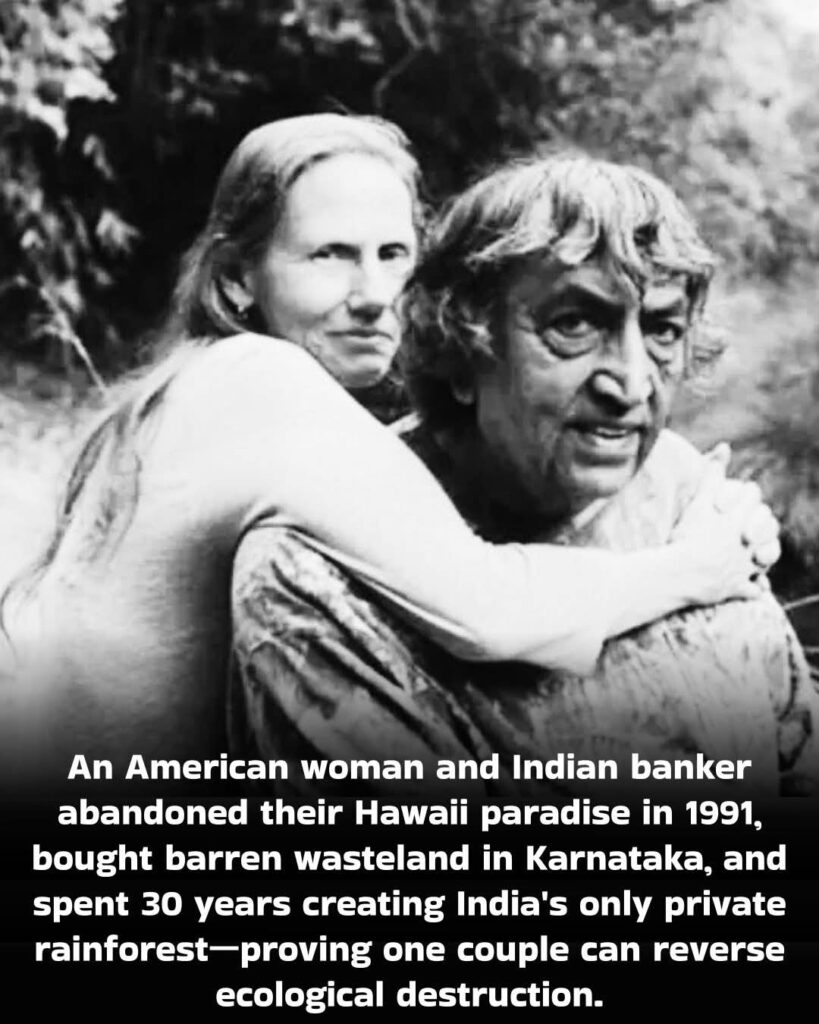
Standing on 55 acres of degraded farmland in Karnataka’s Kodagu district, surrounded by stumps where ancient trees once stood, Pamela and Dr. Anil Malhotra smiled at each other. They weren’t looking for financial returns. They were looking for something far more valuable—a chance to heal the Earth.
It was 1991. The couple had just sold their property in Hawaii, abandoning a comfortable life in paradise for what most would consider madness: purchasing abandoned, denuded agricultural land in southern India with the audacious dream of bringing a forest back to life.
A Love Story Rooted in Nature
Pamela Gale Malhotra grew up on a small farm on the east coast of America, spending her childhood barefoot in the woods, climbing trees and befriending wild creatures. Her Native American heritage taught her to revere nature as sacred. She never imagined she’d meet someone who shared that same devotion.
Anil Kumar Malhotra ran a successful Indian restaurant in New Jersey when they met. Despite their different backgrounds, they discovered they shared one impossible dream: to own a forest of their own.
After college, Pamela landed a pharmaceutical sales job in Denver, Colorado, living among the Rocky Mountains she’d always loved. Anil gave up his restaurant to work in banking so they could be together. But they lived with purpose—subsisting on Pamela’s income while saving every commission Anil earned for the sanctuary they would someday create.
Their honeymoon in Hawaii changed everything. The islands’ beauty captivated them, and they settled there, immersing themselves in its lush forests. But Hawaii also taught them a terrifying lesson. “The mountain heads had been chopped off for strip mining,” Pamela recalls of returning from a business trip to find beloved peaks destroyed. They realized that despite global warming threats, no serious efforts were being made to save forests for future generations.
The Search Begins
In 1986, when Anil’s father died, they traveled to Haridwar for the funeral. The pollution and deforestation they witnessed horrified them. “There was so much deforestation, the timber lobby was in charge, and the river was polluted. And no one seemed to care,” Anil later recalled.
They made a decision that day: they would reclaim India’s forests.
They started in the Himalayas, buying 40 acres in Uttarkashi and founding an NGO called Himalaya Seva Dal to protect forests and empower local communities. But they knew they needed to go bigger. For months, Anil traveled across southern India—Andhra Pradesh, Tamil Nadu, Kerala, Karnataka—searching for the perfect location. Each property disappointed him. Then a neighbor suggested Kodagu.
“When I came here with a friend who suggested I buy this land, it was a wasteland of 55 acres,” Anil said. “The owner wanted to sell because he couldn’t grow coffee or anything else here.” Decades of destructive agricultural practices—intensive cardamom and coffee cultivation—had stripped the land bare. The soil was depleted. Native trees were gone. Water sources had dried up.
But Anil and Pamela saw something else: potential.
For me and Pamela, this was what we were looking for all our lives.
Building a Forest, One Tree at a Time
What made Kodagu special wasn’t just its location in the Western Ghats—one of the world’s greatest biodiversity hotspots—but its critical role in the region’s water cycle. Rainforests generate up to 50% of their own rainfall, making the Western Ghats vital freshwater sources for all of southern India. But Kodagu’s forest cover had plummeted from 86% in the late 1970s to just 16% by the early 1990s, causing severe water shortages across Karnataka.
The Malhotras understood something profound: shortage of fresh water would become a crisis for India and the world. Protecting and restoring forests where water sources originate was the only way to ensure survival.
They bought that first 55 acres and began their work. But their approach was revolutionary—they didn’t just plant trees. They allowed the land to heal naturally.
“Once we bought the land, we allowed the forest to regenerate. We planted native species where necessary and allowed nature to take care of the rest,” Anil explained.
Some native cardamom plants and trees remained on the property. Instead of removing them, the Malhotras planted more indigenous species around them—rosewood, teak, jackfruit, wild fig. As the tree canopy expanded, something magical happened: animals returned.
First came birds. Then small mammals. Then deer. Eventually, the magnificent giants—Asian elephants, Bengal tigers, Indian leopards—began using the land as a safe corridor between the surrounding Brahmagiri, Nagarhole, and Bandipur forest reserves.
But expansion wasn’t easy. They realized there was no use nurturing forest on one side of a stream when neighboring landowners used pesticides on the other side. Legal complications abounded—many land documents weren’t in order, farmers were deep in debt, banks were foreclosing on properties.
So the Malhotras made a decision that would define their life’s work: they would help distressed farmers while expanding the sanctuary. Each time a neighboring farmer faced financial ruin, unable to make loan payments, the Malhotras would purchase their land, providing the farmers with a financial lifeline while adding acreage to the growing forest.
Over three decades, the pattern continued. The 55-acre wasteland became 100 acres. Then 200. Then 300 acres of thriving, rewilded rainforest.
A Sanctuary Comes Alive
Today, SAI (Save Animals Initiative) Sanctuary is officially recognized as India’s only private wildlife sanctuary. It’s completely off-grid, running entirely on solar panels, micro-windmills, and biogas. Water harvesting structures catch and store precious rainfall. The Malhotras live in an eco-friendly home at the sanctuary’s heart, powered by green energy.
The forest now hosts over 350 species of birds and 24 species of mammals. Camera traps capture Bengal tigers prowling through dense undergrowth. Families of wild dogs raise their pups in the safety of the sanctuary. Herds of Asian elephants use it as a critical migration corridor. Leopards hunt sambhar deer under ancient tree canopies. The giant Malabar squirrel leaps between branches. Even rare black-tipped mongooses have been spotted.
The temperature inside the sanctuary is measurably cooler than outside—validating studies showing a 10% increase in forest area creates a 4-degree temperature drop. Springs that had dried up decades ago now flow year-round. The forest has revived entire watersheds.
Scientists and naturalists from around the world visit to study the sanctuary’s remarkable biodiversity. It also serves as a rehabilitation and release site for injured reptiles, birds, and small mammals rescued from illegal ownership in cities.
Perhaps most importantly, the Malhotras never stopped teaching. They spread awareness about wildlife conservation in nearby schools and villages, turning potential poachers into protectors, showing local communities that forests ensure their own survival by enabling rainfall and water security.
A Legacy of Hope
On International Women’s Day in 2017, Pamela stood in New Delhi’s Rashtrapati Bhavan as President Pranab Mukherjee awarded her the Nari Shakti Puraskar—India’s highest civilian honor for women. The award recognized not just her environmental work, but her efforts toward women’s empowerment through the sanctuary’s community programs.
She also received Karnataka State’s Environment & Conservation Award in 2017-2018. Together, she and Anil won the Wildlife and Tourism Initiative of the Year 2014 from Sanctuary TOFTigers Wildlife Tourism.
But for Pamela and Anil, the real reward was simpler: watching the forest breathe.
In November 2021, Dr. Anil Kumar Malhotra passed away at age 80 after a cardiac arrest. He left behind more than a forest—he left proof that individuals can reverse environmental destruction.
Pamela continues their life’s work, living in the heart of the sanctuary they created together. When asked about their motivation, she reflects on their journey: “This is our life’s work and it’s been the most fulfilling experience of our lives.”
The couple had no children—a decision they made early in their marriage. What they wanted instead was a forest of their own. Today, that forest is their legacy, their child, their gift to future generations.
What We Can Learn
The Malhotras’ story carries urgent lessons for our climate-crisis era:
Individual action matters. Two people with a dream and determination transformed 300 acres of wasteland into thriving ecosystem. They proved you don’t need to be a government or massive organization to create environmental change.
Nature heals itself when given a chance. Rather than aggressive intervention, they allowed natural regeneration, planting native species and letting the forest do what forests do best: grow, spread, and bring life back.
Protecting forests protects water. As climate change intensifies droughts, the Malhotras demonstrated that forest restoration is water security. Their work revived springs and streams, ensuring rainfall and groundwater recharge for entire regions.
Economic and ecological goals can align. By purchasing land from distressed farmers, they provided financial relief while expanding conservation—a model others can replicate.
Standing in the sanctuary today, surrounded by towering trees that didn’t exist 30 years ago, listening to the calls of hundreds of bird species, watching elephant families pass through on ancient migration routes, you understand something profound:
What seems impossible—reversing decades of environmental destruction—is entirely possible when individuals commit themselves to the patient, loving work of restoration.
Pamela and Anil Malhotra didn’t just create India’s only private rainforest sanctuary. They created hope. They proved that even the most damaged land can be brought back to life. They showed that the fate of our forests, our wildlife, our water, our climate—ultimately rests not with distant authorities, but with people willing to dedicate their lives to healing the Earth.
In the lap of Mother Nature, Anil once marveled, you realize the Earth is only a microdot in the universe. Yet even on this tiny dot, in one small corner of India, two people with an impossible dream changed the world.
Their forest stands today as a testament: it’s never too late to heal what’s been broken. It’s never too late to bring life back. It’s never too late to create a legacy of hope.
And if they could transform 55 acres of wasteland into 300 acres of thriving rainforest, imagine what we could accomplish if we all planted our own forests, in whatever form they take—whether physical trees or seeds of change in our communities.
The Malhotras gave us more than a sanctuary. They gave us proof that the future doesn’t have to be defined by loss. With patience, love, and unwavering commitment, we can restore what’s been lost and create abundance where there was once only despair.
Their forest breathes. And in its breath, we find hope for all our forests, all our futures.

Responses